Saturday, June 26, 2021

Alice Curtis Fuller Wright Frazer LeRoy

My great-grandfather, Frederick Harriman Wright, is a difficult subject to nail down. An artist & sculptor who lived from 1863 through 1933, I have not been able to locate one photograph of him. The only image we have in the family archives is this very intense self-portrait.

F. Harriman Wright

Before marrying my great-grandmother, Marie Antoinette Finck, he was married to Alice Curtis Fuller (1865-1947). They were married on October 9, 1886 in Manhattan. It was a short marriage and they were divorced in 1888. I found her to be an interesting woman, however, and continued to do some research on her.

Alice Fuller was the daughter of William James Appleton Fuller of Boston and Charlotte Elizabeth Oakes of Charleston, SC. Mr. Fuller was an attorney who had graduated from Harvard. Mr. Fuller was a master chess player and appears to have lead an interesting life:

William James Appleton Fuller was born at Boston, April 8th, 1822.
After spending some time at Harvard College, he paid a brief visit to Europe. He commenced playing chess at sixteen; and enjoyed the instruction of Mr. Hammond, who, with Dr. Oliver, used to play with him at odds. A checkered life gave him but few opportunities to cultivate the game. Among his numerous adventures, we are told that "he has hunted whales in the Polar seas - swam for a wager, and most unexpectedly for life, at Niagara Falls and among the amphibious Fayaways of the tropics - taught school and edited newspapers in the Far West - lost his way and everything else but his life, in crossing the wilderness on his route to California - doubled every cape and horn on the globe - and last, not least, drunk champagne with M. Godard while high up in a balloon." Although he taught chess while on a whaling voyage to the officers of the ship, and encountered in Cuba the magnates of the ever-loyal isle, he did not resume regular practice of the game until he settled in New York in 1854. Then he entered the Club, and in the following year took charge of a Chess department in Frank Leslies Illustrated Newspaper, where he displayed high literary as well as powerful Chess abilities. He was chiefly instrumental in giving accelerated impulse to the outward march of the game, and his brilliant, humorous, and instructive column aroused an enthusiasm for our sport, which had never before been experienced by the public of this country. Mr. Fuller is now (1859) engaged in the successful practice of the law, in New York, and is an Honorary Member of the New York Club.

-Prof. George Allen, 1859 (copied from http://www.edochess.ca/batgirl/Fuller.html)


Back to Ms. Alice... after divorcing Frederick H. Wright, she married Dr. Francis MacDonald Frazer in September of 1896. MacDonald was the son the Rev. Dr. Frazer, pastor of the First Presbyterian Church of Newark, NJ.

Wednesday, May 5, 2021

A Peek Into the Hurley Family & The Polo Grounds

(L-R) Vera Hurley, Borromeo Hurley and newly married George Wright &Madeleine Hurley

August 1944
 

On my mother’s maternal side, we have the Hurley family. My grandmother’s name was Madeleine Elizabeth Hurley and was born on May 13, 1919. She would have been 102 in a couple of weeks but she passed away in February 2006 at 87 years old. She was born in Manhattan to Bartholomew J Hurley (1879-1963) and Elizabeth C Hoffman (1880-1948). Like most Manhattanites, they lived in an apartment building and at the time of her birth, the family lived at 62 East 129 St near Park Ave. The building still stands but appears to have been heavily renovated as opposed to many of the building on the street. Madeleine was the middle child of the family. Her sister, Veronica, or as we also knew her as Aunt Vera, would live near or with my grandmother for most of their lives. There was a little brother, Borromeo, who was born in 1921. According to the census reports they lived on East 129 St for several years until a move to the Bronx, where they lived at 1021 University Ave near West 165 St. The family remained in Highbridge section of the Bronx for many years.


On the left is a young Bartholomew Hurley as a police officer. Right is Elizabeth sitting in Bart's lap during a summer visit to Lebanon Springs, NY.


In the 1900 census, Bartholomew was 21 years old and listed as a lithographer. His family lived for a few years in Cornwall On The Hudson when his father, Bartholomew Sr. ran a hotel. He then became a police officer with the NY-Pennsylvania Railroad for a few years. The 1910 census states that he was a theater manager and the family had moved back to the city residing at 166 East 82 St. He eventually took a job with the Independent City Owned Rapid Transit Railroad as a fare collector. This railroad later became the IND line of the NYC subway system. According to my mom, Bart was a token clerk at he the 155 St – Polo Grounds station for many years. I have often wondered how many spectacular sporting events he may have worked in the subway station beneath the action. Did he sneak into the stadium during his lunch break to catch Christy Mathewson win one of his record 373 games? Was he there when Bobby Thompson’s “Shot Heard ‘Round The World” defeated their Brooklyn rivals? How about when Willie Mays made his famous over the should basket catch? There wasn’t just baseball at the Polo Grounds either. Maybe he worked the crowds headed to one of the many Army-Navy football games or those between the Ivy League rivals Fordham vs Columbia University. However, he was surely retired by the time the NY Mets played their first couple of seasons there before Shea Stadium was built.

The Polo Grounds Stadium

Some irony is found with ole Bart’s position at the subway station at West 155 St which sat just beyond the shadows of Coogan’s Bluff. Twenty-four years after he passed away I would be walking the same mezzanines as a NYC Transit Police Officer. The Polo Grounds were long gone by then, replaced by several towering public housing buildings of the same name that were notorious for their crime. Eight years after my great-grandfather died and 15 years before I joined the police department, a horrific incident occurred just down the street from the subway entrance. Two NYC policemen, Waverly Jones and Joseph Piagentini, were assassinated by avowed members of the Black Liberation Army. The suspects in these killings were also responsible for shootings and deaths of other police officers in California.

One of the longest and most lonely nights of my career I was posted at the West 155 Street station. It was New Years Eve of 1987 and I was stuck there for 12 long hours starting at 4PM. It was cold and desolate with the sounds of fireworks, or was it gunshots, echoing down the stairways throughout the cavernous subway. The times had changed for certain from the heyday of my great-grandfather to the footpost of my young police career.

Tuesday, April 20, 2021

Going Down To Monto, Lan-ge-roo!

It’s been quite a while since I have made any entries in this family ancestry blog. I cannot state any one particular reason why except life carries you in different directions.

I had restarted my genealogy research a year or so ago and have made some interesting discoveries, at least to me. I have delved a bit deeper into the DNA aspect of the hobby and discovered several connections to distant relatives within my family tree. This has given me affirmation to much of the research.

Peter Simon Fanning III


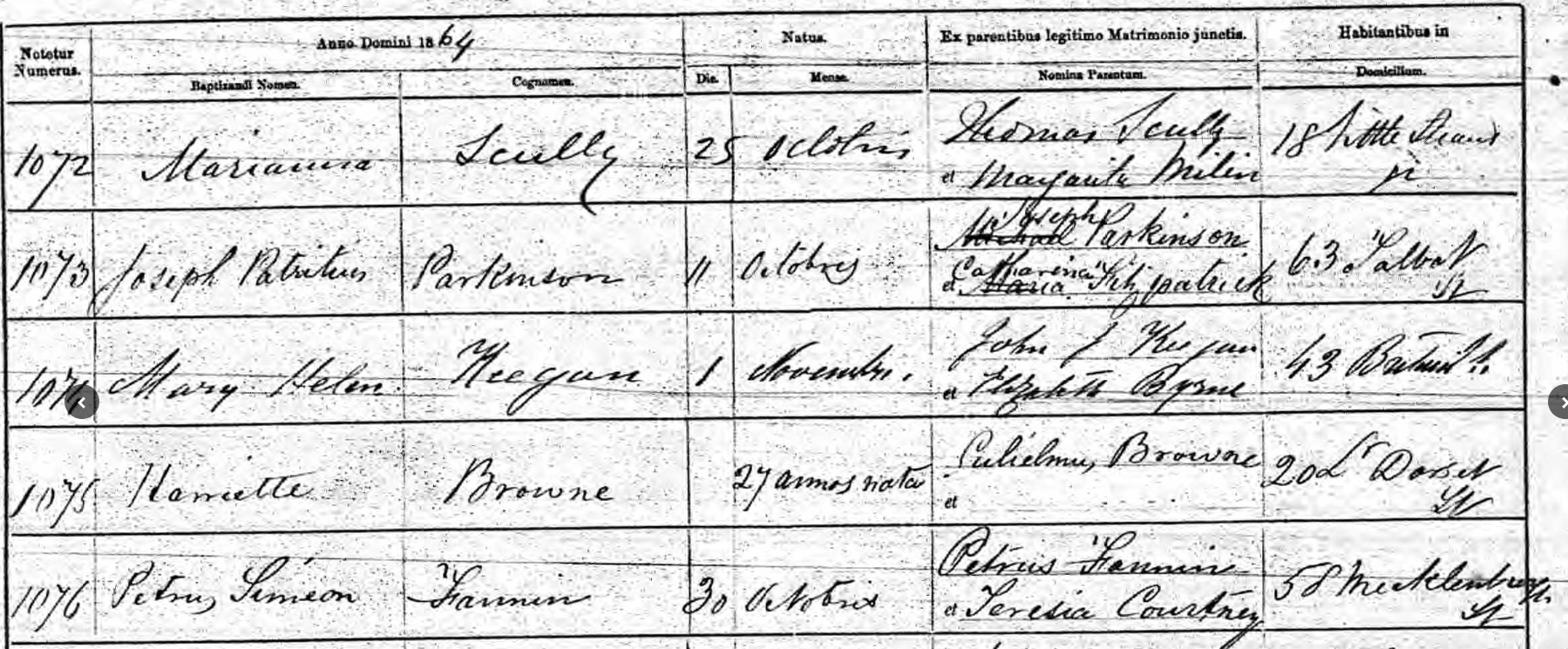
However, this blog post goes back to my great great grandfather, Peter Simon Fanning III, and his family’s life in northern Dublin in the mid 19th century. While going over some records I found that Peter’s parents, Peter Fanning and Teresa Courtney, lived on Mecklinburgh St when he was born in 1864. I couldn’t find it on modern era maps and searched out its history online.

I first found a New York Times article that described Mecklinburgh Street as it ran through the center of a square mile of brothels, speakeasies, and slums known as Monto. The next street over was then called Montgomery Street, where this slum area obtained its nickname Monto. It was an infamous red-light district, perhaps one of the most well known in Europe in its day. James Joyce wrote of the area in Ulysses, which he dubbed Nighttown.

By all accounts, Monto was truly abysmal. The streets were lined with brothels and lowly taverns. Its proximity to the railway made it an easy entrance and escape for those looking to get their fill of society’s evils undetected. It became a dumping place for unwed pregnant women. Their children often landed in the hands of nuns who operated orphanages that surrounded the district.


A map of Dublin's red-light district known as Monto.


In 1864, the Fannings lived at 58 Mecklinburgh Street. I am not certain if this was considered the upper or lower end of the street. This apparently made a difference as the working class residents of the upper end lobbied to have their portion of the street renamed in 1886 to Lower Tyrone Street to disassociate itself with the seedier end of the road. In the 17th century, the road was called Great Martin’s Lane and in 1911 it was renamed again Waterford St on one end and Railway Street at the other. The whole area was torn down during the 20th century and was reconstructed in an effort to distance itself with the horrors of its past.

From the genealogical value of this post, the document where this info was gleaned came from the baptismal records of St Mary's Pro-Cathedral on Marlborough Street. Young Peter was given the sacrament of Baptism on November 4, 1864. All writing was done in Latin and their last name was actually listed as Fannin. One small mystery has emerged though. The record (a section that is not pictured here) has Magarita O'Brien as the child's sponsor (I assume this is a Godmother) and there is no male sponsor listed.


Peter Simon Fanning baptism record.

Coincidentally, when I was a young father, I had a long trek across Long Island to pick up my son for our weekends together. I often played Irish music on cassettes in my car. On one such tape there was a song by the Dubliners called Monto. My son did not enjoy much of the music on these trips but he did fancy this particular song and its catchy refrain. “Going down to Monto, Monto, Monto. Going down to Monto, lan-ge-roo… to you!” Here is a YouTube of Ronnie Drew's version of the song… https://www.youtube.com/watch?v=jSXwttg88Zo


To read a bit more on Monto and Mecklinburgh Streets visit:

https://wideandconvenientstreets.wordpress.com/2015/08/24/nighttown-dublins-monto/

https://www.nytimes.com/2018/01/15/world/europe/magdalene-laundries-ireland.html

Sunday, February 26, 2017

William Welles Bosworth

Meet my "second cousin 3x removed", William Welles Bosworth. Another notable descendant of William Little Hull, my 4x great grandfather.

This is from his wikipedia page:

William Welles Bosworth (May 8, 1869 – June 3, 1966)[1] was an American architect whose most famous designs include MIT's Cambridge campus, the AT&T Building in New York City, and the Theodore N. Vail mansion in Morristown, New Jersey (1916), now the Morristown Town Hall. Bosworth was also responsible to a large degree for the architectural expression of Kykuit, the famous Rockefeller family estate north of Tarrytown, New York, working closely with the architects William Adams Delano and Chester H. Aldrich and the interior designer, Ogden Codman.[2]

Bosworth is not as well known in the United States as other Beaux-Arts architects of that time, because his career, under the auspices of John D. Rockefeller, Jr., led him to France in the 1920s, where he was put in charge of the restoration of the Palace of Versailles and Notre-Dame de Reims, projects Rockefeller was interested in and that he generously financed. In time, Bosworth was awarded the French Legion of Honor and the French Cross of the Commander of the Order of Arts and Letters, one of the few Americans ever to receive such honors. In 1918, Bosworth was elected into the National Academy of Design as an Associate member, and became a full member in 1928.

William Welles Bosworth

Wednesday, February 22, 2017

"Six Degrees of Separation" to President Woodrow Wilson

Once upon a time.... there was a husband and wife named William Little Hull (1786-1836) and Lydia Packard Hull (1781-1970). They had a 4x great grandson... that would be me! However, they also had a 3x great grandson, Donald Wilson Thackwell (1912-1962), who married a woman named Mary Faith McAdoo (1920-1988). The marriage took place in Delicias, Mexico 1946. I don't know when they were divorced but her next marriage was in 1966. Mary was the daughter of US Secretary of the Treasury William Gibbs McAdoo. Mary was also the granddaughter of US President Woodrow Wilson!

Mary Faith McAdoo as an infant with sister Ellen looking over her.

President Woodrow Wilson

US Secretary of Treasury William McAdoo

Mary Faith McAdoo had two other husbands. She was born on April 6, 1920 in New York City and died in Santa Barbara, California on November 14, 1988.

Saturday, June 18, 2016

A Fanning Father's Day


Everyone has a father. Not everyone has a dad. I am fortunate to have a great dad.

My dad, Richard Fanning, has been a great inspiration to me. He and my mom raised my sister and I with a wonderful sense of family pride. He made sure the we did family things even when there was not a lot of money on hand. Trips to the Bronx Zoo & Botanical Gardens and the local beach (Orchard or Rockaway) grew into trips to Virginia Beach, Disney World, Chincoteague Island, Massachusetts for skiing, and frequent visits with relatives even if it meant taking the subway to a bus at the Port Authority.


My dad's promotion to Deputy Chief

My dad spent 32 years as a fireman in NYC after 2 years as a Transit Policeman. I watched him work hard and rise through the ranks of the FDNY to become a Deputy Chief. There were usually lots of fire science books and binders around the house during those years before a promotion test and mom made sure she occupied us kids so not to disturb him while he was studying. I did not become the excellent test taker he was but I did come to realize the value of hard work because of him. I would like to think that I inherited his sense of service and bravery. I have heard from many in the fire department of what great guy he is and a pleasure to work with/for. I used to love to read his scrapbook as a kid with the articles of heroics and mayhem... The Jennings Street Collapse, the two times he apprehended burglars in our Bronx apartment building, and narratives of awards earned. I relished the visits as a young lad to the firehouse. If there was such a thing as direct deposit back then, I surely would have been cheated of many visits to Ladder 19 & Engine 50.


Not everyone can say their dad was Superman.


My dad has a great sense of humor and is always the life of the party sometimes to my mother's chagrin. I believe he inherited that from his parents, Joe & Vera, who knew how to have a good time. I always loved the stories of my grandparents summers in the Rockaway bungalow courts and the St. Ignatius parish hall in Yorkville. One particular story had them and their friends in either O'Gara's Bar or the Paddywagon Pub across from Playland when a fight broke out. They were caught in the back of the establishment near an open window. Rather than get caught up in the fray, the men passed the girls through the window and climbed out behind them but not before grabbing a few pitchers of beer... not all of them were theirs!

Poppy Joe tries a hand at the bodhran drum.


My grandfather, Joseph Patrick Fanning... originally known to me as Pop Pop which later became Poppy Joe, was a hard working man, too. He worked in the printing business and became his own boss when he opened his own agency, FanningType. He, too, valued the family time when he could. Although my father has different recollections from hen he was a kid, my experience as the eldest grandchild included the backyard pool in NJ and beach house rentals in the Jersey Shore's Lavalette and then Long Beach, NY. As I grew older, I was fortunate to live about a mile from him after we both settled in Long Beach permanently. It was nice share a beer with him and visit for a short time unannounced during a bike ride with the kids. It is wonderful that he was able spend time with own great-grand kids. I did not get to meet my great grandfather,also Joseph Patrick Fanning.

Joseph Patrick Sr., the great grandfather, was born in Ireland in 1898 and immigrated to the US as a child with his parents. He grew up in Hell's Kitchen and raised his family there, too. Although born Joseph Patrick, he was known as "Paddy" and I have imagined him speaking in a slight brogue despite being taught the language here in the US. Census reports cite his occupation as "driver" in trucking and "chauffeur for private family".  He passed away when my dad was only 3 years old and, unfortunately, never had a relationship with him. If my memory serves me correctly Poppy Joe told me Paddy drove a car for the Ruppert family. Col. Jacob Ruppert was a well known businessman in NYC. He inherited the Ruppert Brewery in Yorkville, was a Tammany Hall politician, and owned the New York Yankees. In fact, it was Ruppert who purchased Babe Ruth from the Boston Red Sox in 1919. Coincidentally, Harry Herbert Frazee Sr., the man who sold The Babe to fund his Broadway production of "No, No Nanette" was the father-in-law of my maternal 1st cousin (2x removed) Anna May Hoffman. And to make the family connection greater, Vera Kempen Fanning's (my paternal grandmother) father & grandfather both worked at the Ruppert Brewery at some point, too.

Paddy Fanning


And the man responsible for the Fannings being in America was Peter Joseph Fanning. in 1891, at the age of 28 years old, he moved his family to New York. The 1910 census reports that his occupation was "horse shoer". I am sure he led a life of hard work, too. I don't have much information on Peter. I don't know when he died but I know he wasn't wealthy when he did. Judging from his photo, he was likely a proud man. And I believe he would be proud of all the Fanning fathers that came from his lineage.

Peter Fanning

Not forgotten on this father's day is my other grandfather, who died when my mom was young, and the other great grandfathers whose blood runs through my veins.

George Wright, maternal grandfather

Frederick Harriman Wright, maternal great grandfather

Bart Hurley, maternal great grandfather


Henry "Henny" Kempen, paternal great grandfather
Frederick Finck, maternal 2x great grandfather

Jakob "Joe" Schalk, paternal 2x great grandfather

William Hoffman, maternal 2x great grandfather

Bartholomew Hurley Sr., maternal 2x great grandfather

Wednesday, March 9, 2016

My First Brush with the Revolutionary War

As I continue to work my way through the Hull family lineage, I introduce to you my 5X great grandparents, Stephen Hull (1743 - 1803) and Comfort Babcock (1746 - 1806).

Stephen Hull, of Stonington, Ct., is the first ancestor I discovered who served in the American Revolutionary War as a member of the Continental Army. Using Ancestry.com, I viewed the 1920 "Sons of the American Revolution" application of Harold Bragdon Winslow. He is also a descendant of the Hull family and has documented that Stephen and his father, also named Stephen, served in the 8th Connecticut Regiment under the command of Captain Thomas Wheeler & Thomas Holmes between September 8 - November 17, 1776. They also served under Lt. Col. Oliver Smith's regiment out of New London but no dates were given. The site also provides a copy of the actual payroll for this militia and shows one of the Stephen Hulls as a sergeant. Also listed are some other names that I have become familiar with during my genealogy research, such Denison, Babcock, and Billings. I have not been able to locate much of the activities of this regiment during the time period indicated.

Roll Call of members of the Eighth Connecticut Regiment in 1776.

A year prior to enlisting in the army Stephen Hull had married Comfort Babcock in Willington, CT. According to other family trees that I have connected to they had seven children:
  • Elias (1778-?)
  • Comfort (1780-?)
  • Ami (1782-?)
  • Latham (1784-?)
  • William Little (1786-?) *my 4x great grandfather
  • Matilda (1788-?)
  • Lucretia (1792-1870)
  According a variety of sources, they resided Willington, CT., Windham, CT., and Stonington, CT. According to the pension roll of the US Revolution, Stephen died in 1803 in Willington. The Newspaper Abstract from the Northeast reports that Mrs. Comfort Hull died in Boston at the age of 66.